
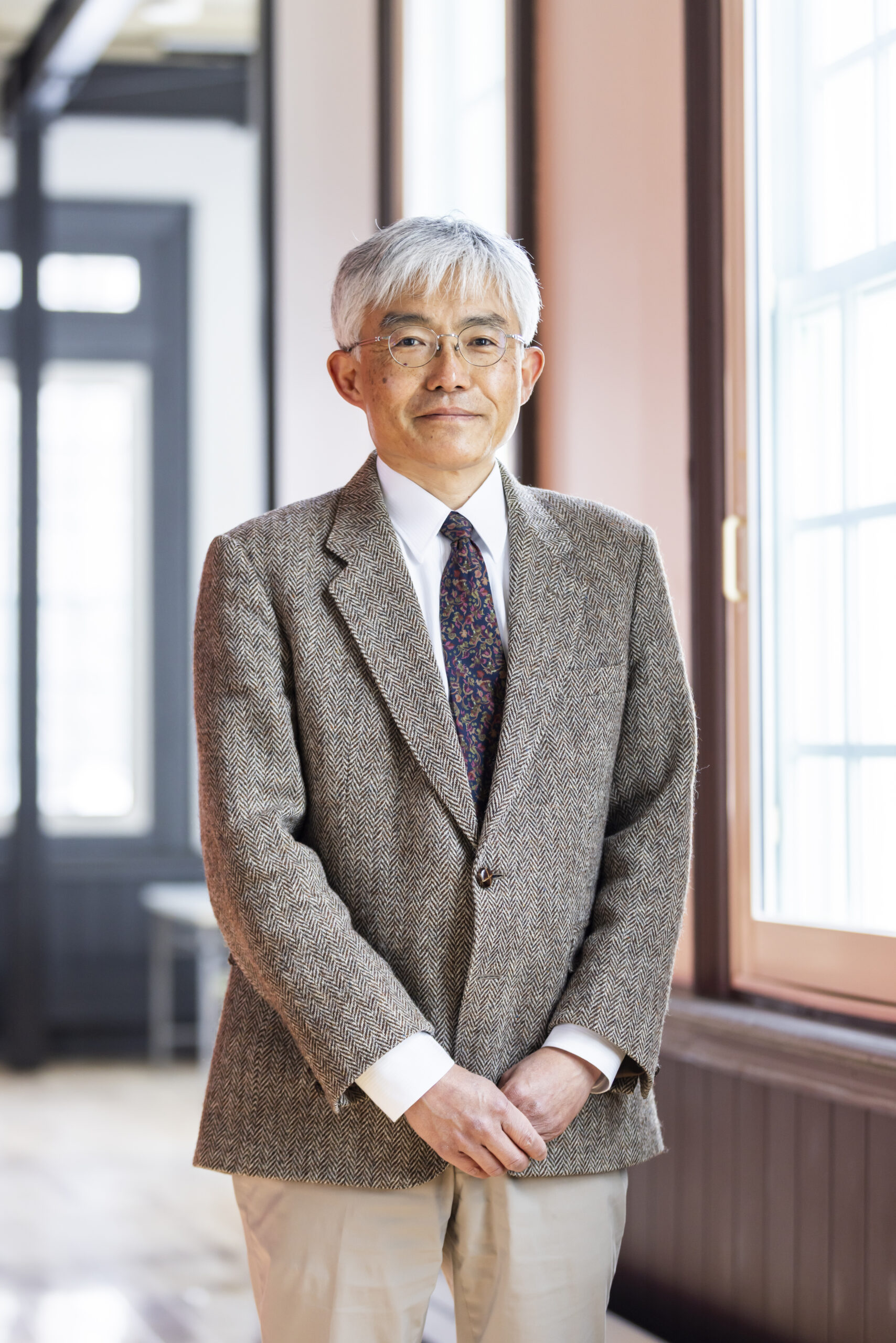
Dean of Research Faculty of Agriculture,
Graduate School of Agriculture,
and School of Agriculture.
The history of the Hokkaido University Undergraduate School of Agriculture, Graduate School of Agriculture, and Research Faculty of Agriculture (hereafter referred to together as the Hokkaido University School of Agriculture) can be traced back to its establishment in 1876 with the opening of Sapporo Agricultural College. The first faculty to give instruction at the school were scouted by Dr. William S. Clark, the first vice president of the school, and brought over the same teaching methods that were being used in American universities at the time. Instruction was not limited only to that of the agricultural sciences but incorporated basic instruction in natural sciences and other fields including foreign language study and what we might call physical education today. With a combination of novel teaching methods, Hokkaido’s strikingly different climate from the rest of Japan, and the many unique young people attracted by the two, over time the school developed a one-of-a-kind academic atmosphere producing a number of graduates who left their mark on the world. Having inherited this unique atmosphere, it is with great pride that the faculty and staff of the Hokkaido University School of Agriculture continue to carry on the legacy cultivated by our predecessors at Sapporo Agricultural College.
Surrounded by lush expanses of nature and as one of the nation’s leading food production bases, the Hokkaido University School of Agriculture has continued to put an emphasis on the research efforts in Hokkaido that started in the days of Sapporo Agricultural College. Thanks to its resources both on and off-campus, such as its access to large agricultural fields, wetlands, forests, natural parks, and more, our program provides immediate access to hands-on education outside of research laboratories. This in turn allows for all areas of interest to be researched in-depth and in-house, ranging from micro-level mechanisms to macro-level phenomena and beyond. Sometimes researchers and students of our school leave Hokkaido, and even Japan, to gain understanding of situations, climates, ecological systems, and agricultural research in the outside world and bring back with them the tools necessary to continue searching for solutions to their own research questions. In this way, one could say we embody the philosophy of “practical learning” (hands on study) that Hokkaido University holds dear.
Agriculture is a discipline that must respond to the demands of change through each era. There are discussions about when it began, and perhaps its exact origins have been lost to the archives of history, but the first record of agricultural production and know-how is often considered to be the birth of agricultural sciences. Modern scientific discoveries then expanded the discipline further through a deepening of academic scope. It cannot be denied that thanks to the contributions of modern science, many successful proposals in agricultural sciences have aided in the endeavor to preserve human survival and flourishing. However, the field of agricultural sciences does not hold the key to ushering in utopia, and we should neither forget the failures the industry has seen nor let our attitude towards the scientific method waver, but rather we ought to learn from these failures to ensure that we do not repeat the mistakes of the past. Given this, it is crucial to cultivate a scientific way of thinking, through which we can derive lessons from past failures to pass on to future generations. At present, the Hokkaido University School of Agriculture is composed of seven academic courses in its undergraduate program—Agrobiology, Applied Bioscience, Bioscience and Chemistry, Forest Science, Animal Science, Bioresource and Environmental Engineering, and Agricultural Economics—and three courses in its graduate program: Frontiers in Production Sciences, Frontiers in Biosciences, and Frontiers in Environmental Sciences. While each specialization varies in subject matter, there is no doubt that they all share an emphasis on scientific training through practical learning. Our graduate programs in particular work to expand students’ perspectives through the intentional grouping of highly specialized fields across broader areas of study.
Today our society faces many imminent concerns such as climate change, an ever-changing socio-political climate, international tensions, and an unprecedented acceleration of technological advances, with some of these issues already appearing to threaten human flourishing and sustainable development. In order to combat these issues, it will not be enough to simply find solutions. We will also need to raise up individuals who possess scientific literacy and can make sound judgments when facing future challenges. Here at the Hokkaido University School of Agriculture, it is my hope that our educational instruction and research will live up to the hopes of society to find answers to current issues and carry our world into the future.